
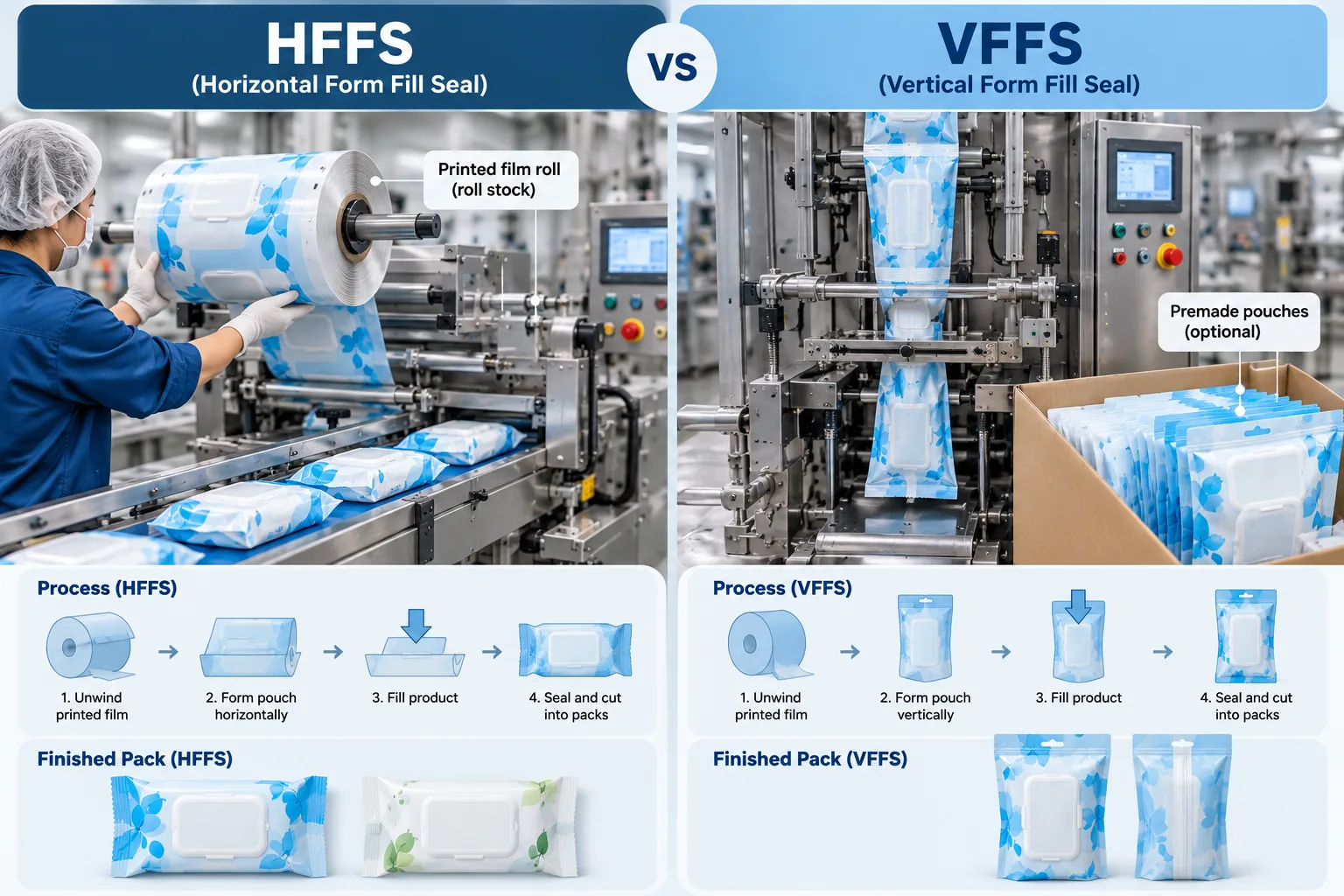
When brands weigh rollstock against premade pouches, most compare two numbers: the film price per pack and the finished bag price per pack. The film always looks cheaper. But that gap is only one line in a longer cost list, and it can shrink fast once you add the machine, the labour, the changeovers and the waste.
This guide answers the rollstock vs pouch question the way a buyer at volume needs it answered. It walks through every cost line, gives you a simple break even formula, and shows how the choice plays out for wet wipes, sanitary pads, diapers and face masks.
Rollstock vs pouch: the short answer
Rollstock usually gives the lowest cost per pack once a SKU runs in long, steady batches on a form fill seal (FFS) line. Premade pouches cost more per unit, but they need less money up front, change over faster and suit brands with many SKUs, short runs, or features such as zippers and handles.
The point where rollstock pays back depends on three things: how many packs each SKU runs per year, how often you change sizes or designs, and what the FFS line costs you each year to own and staff.
What you are actually buying
Rollstock
Rollstock is printed or plain packaging film wound onto a core and delivered as a reel. Your machine pulls the film off the reel, folds it, seals it into a pack, fills it and cuts it free, all in one pass. Horizontal machines (HFFS) are common for flow wrapped packs and sachets. Vertical machines (VFFS) are common for pillow and gusseted bags.
Tansox supplies custom printed rollstock in web widths from 100 mm to 1,750 mm, in structures such as PET/PE, BOPP/PE, PET/AL/PE and PA/PE. Rollstock is quoted by weight or by reel, not by the piece.
Premade pouches
A premade pouch arrives as a finished bag. The supplier has already printed, laminated, sealed and cut it, and added any zipper, handle, gusset or tear notch. Your line opens it, fills it and seals the top.
Common premade formats in hygiene include flat packs, gusseted bags, premade stand up pouches and single use sachets. At Tansox, custom printed bags start at 10,000 units per SKU.
Where the money goes: seven cost lines
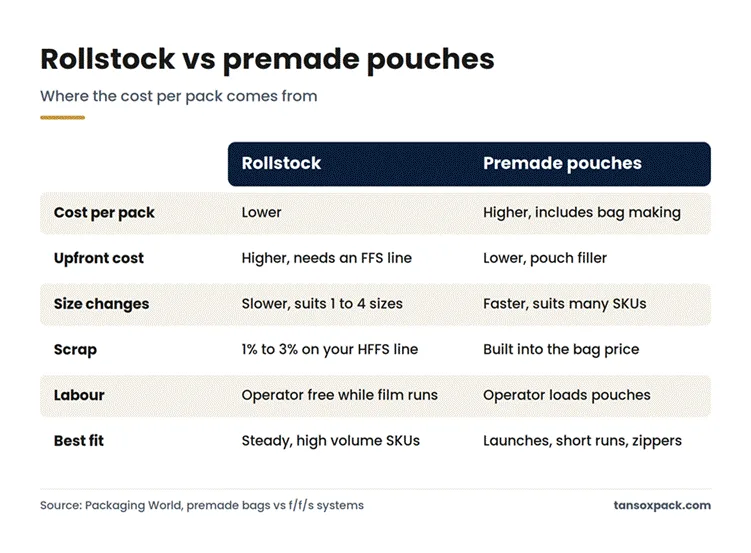
The film or bag price is the number on the quote. Your real cost per pack is the sum of seven lines, and the table below shows which way each one leans.
| Cost line | Rollstock | Premade pouches |
|---|---|---|
| Packaging material | Lower per pack | Higher per pack, includes bag making |
| Print cylinders | Same for both if the artwork layout stays the same | Same for both if the artwork layout stays the same |
| Machine | FFS line, higher capital cost | Pouch filler, lower capital cost |
| Labour | Operator can do other tasks while the reel runs | Operator loads pouches |
| Changeover | Slower | Faster |
| Scrap | Made on your line | Built into the bag price |
| Inventory | Film can sometimes serve more than one size | One size and one design per bag |
1. Packaging material
A premade pouch includes the cost of making the bag. A rollstock pack does not, because your machine does that step. This is the main reason rollstock costs less per pack. The more features a pouch has, the wider the gap, since a zipper, a handle or a shaped bottom all add bag converting work at the supplier's factory.
2. Print cylinders
Gravure printing needs one engraved cylinder per colour. That is a one off cost per design, and it applies to both routes. It only changes your comparison if switching formats changes the artwork layout or the repeat length, because new gravure cylinders would then be needed. Ask before you switch.
3. Machine
An FFS line is a larger investment than a premade pouch filler. Spread its price, plus maintenance and spare parts, across the years you expect to use it. That yearly figure is the fixed cost that the rollstock saving has to repay.
4. Labour
Packaging World notes that a pouch filling machine needs a full time operator to load the pouches, while an FFS operator can attend to other work as the reel runs. Rollstock lines still need people who can thread film, set seal temperatures and fix print registration, so check you have those skills on every shift.
5. Changeover
Every size or design change stops the line. Production monitoring company Vorne measures changeover from the last good unit of one run to the first good unit of the next, and counts that time as lost availability. Pouch fillers usually switch sizes faster than FFS lines, so a SKU list full of short runs eats into the rollstock saving.
6. Scrap and start up waste
With rollstock, the waste happens on your line: threading, splices, seal setting and registration. The same Packaging World guide puts typical scrap on a horizontal FFS machine at 1% to 3%. With premade pouches, the supplier's waste is already built into the bag price.
7. Inventory, storage and freight
Rollstock in a shared structure and width can sometimes serve more than one pack size. Premade pouches are made for one size and one design, so a discontinued SKU can leave unused stock behind. For long sea freight, ask your supplier how many pallets 100,000 packs take in each format, because that changes your landed cost.
How to find your break even volume
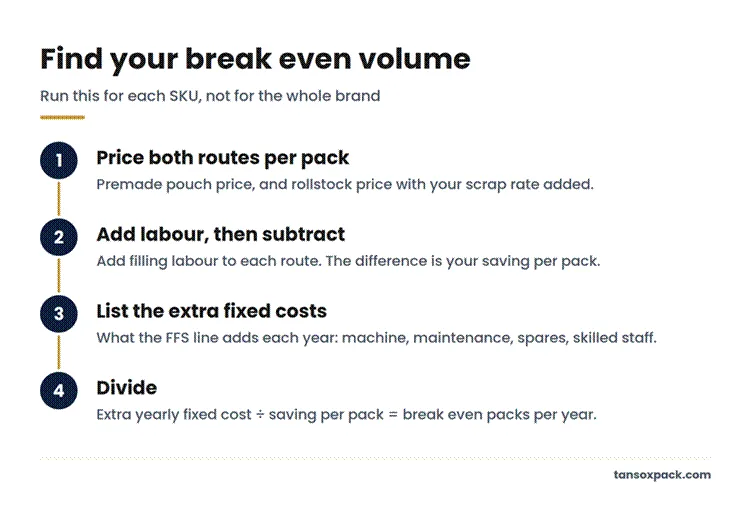
This is where the rollstock vs pouch comparison becomes a number. Use this formula for each SKU:
Break even packs per year = extra yearly fixed cost of the rollstock route ÷ saving per pack
The saving per pack is the premade pouch price plus its filling labour, minus the rollstock price (with your scrap rate added) plus its filling labour. The extra yearly fixed cost is what the FFS line adds each year compared with your premade route: machine payments or depreciation, maintenance, spare parts, extra technical staff and training.
Here is a worked example. These are round numbers to show the maths, not Tansox prices.
- Premade pouch at 6.0 US cents per pack, plus 0.5 cents of filling labour, gives 6.5 cents.
- Rollstock at 4.0 cents per pack with 2% scrap gives 4.08 cents, plus 0.4 cents of labour, gives 4.48 cents.
- The saving is about 2 cents per pack.
- The FFS line adds 40,000 US dollars a year in fixed cost.
- Break even is 40,000 ÷ 0.02, which is 2,000,000 packs a year, or about 167,000 a month.
Above that volume, rollstock saves money every year. Below it, premade pouches are cheaper overall. Two quick checks show how sensitive the answer is. If the saving per pack halves, the break even volume doubles. If you already own an FFS line with spare capacity, the extra fixed cost is close to zero and rollstock pays back almost at once.
Packaging World also gives a rough shortcut: below a certain yearly volume, premade pouches make more sense, and it puts that point anywhere from several hundred thousand to over 1 million units a year. Your own numbers matter more than any rule of thumb, so run the sum per SKU, not across the whole brand.
When each format wins
Premade pouches win when
You run many sizes or designs. A 2019 PMMI assessment, reported by Packaging Strategies, found that premade pouch machinery suits shorter runs and easier changeovers, while FFS machinery suits longer runs at higher speeds.
The pack needs a zipper, handle, shaped bottom or resealable lid. The same assessment notes that premade pouch machinery handles attachments such as zippers well, while adding them to an FFS line means extra modules and more setup.
Your products are filled by a contract packer with no FFS line, or demand is new or seasonal. If you cannot forecast steady growth, an FFS line may take years to pay back.
Rollstock wins when
You run one to four sizes on long, steady batches, and the artwork rarely changes. Your forecast sits well above your break even volume. Your team can run, maintain and troubleshoot an FFS line on every shift.
Rollstock vs pouch in hygiene packaging
Most guides on this topic talk about snacks and coffee. In hygiene and medical products, the choice usually depends on the filling or bagging machine already on your line, and many brands end up running both formats.
Wet wipes
Many high volume wipes brands flow wrap their soft packs from printed rollstock on horizontal machines, then apply a resealable label or plastic lid on the same line. Premade wet wipes bags with a resealable lid suit smaller runs, new variants and brands without that equipment. Both routes need a moisture barrier film, so the structure question is the same either way. Our wet wipes packaging page covers the structures we use.
Sanitary pads and maternity pads
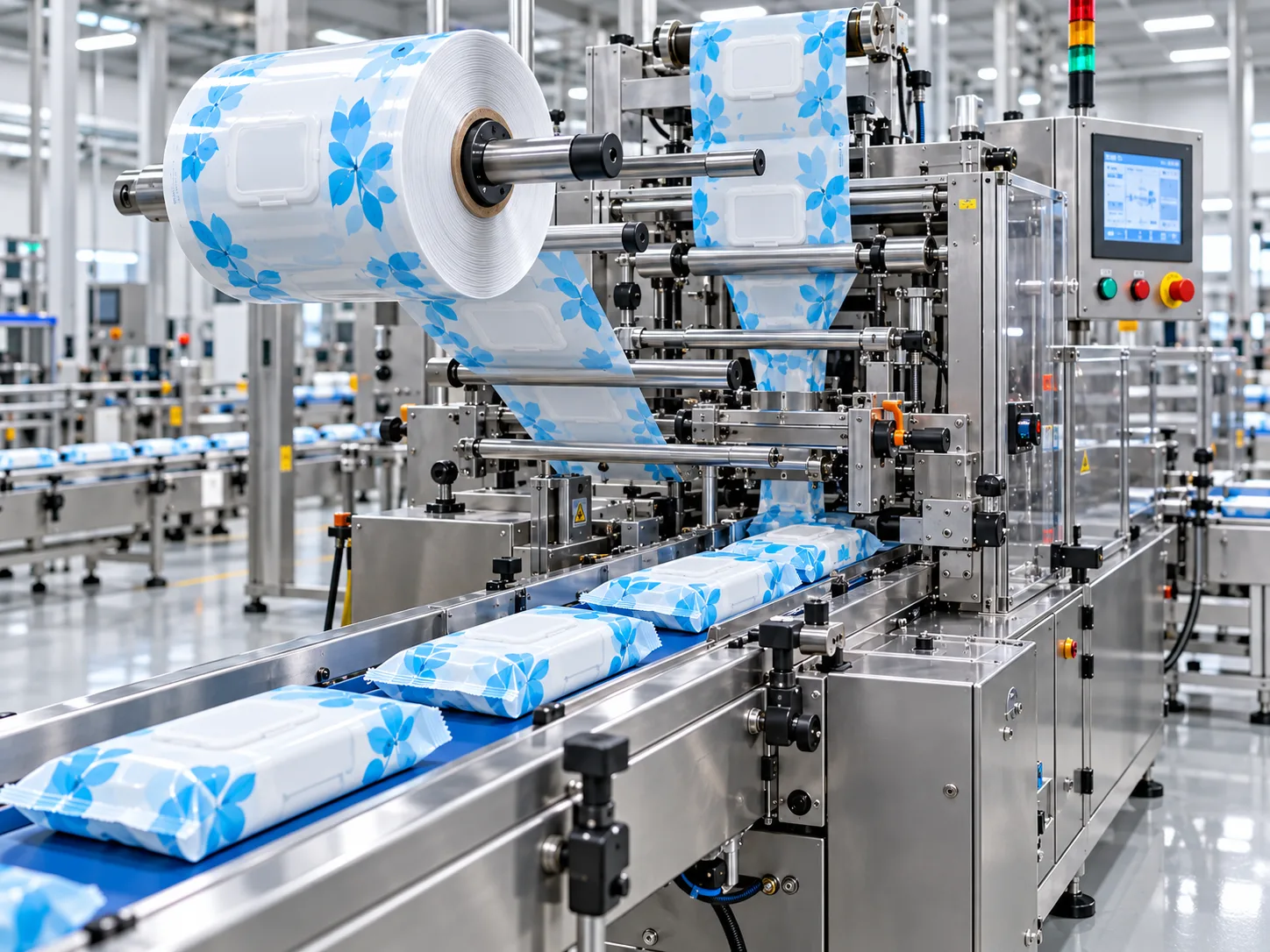
Individual pad wrappers are normally made from a reel of thin film on the pad production line itself, so rollstock is already part of most pad lines. The rollstock vs premade choice comes back for the outer retail pack, which can be a premade bag or a pack formed from film on a bagging machine. See the formats we supply for sanitary pads.
Diapers, pull up pants and underpads
These packs are bulky and heavy. Many lines fill premade side gusset bags with handles on a stacker and bagger, while some machines form the bag from film instead. Your bagging machine decides which format you can run, so start there before you compare prices. Read more about packaging for baby diaper packs.
Face masks and disposable products
Single masks are often flow wrapped from rollstock at high speed, while multi packs and outer retail bags are commonly premade zipper or gusseted bags. A mixed setup like this is normal, so do the cost sum per pack type. See the mask formats we supply.
Questions to ask before you switch to rollstock
- What web width, core size, maximum reel diameter and unwind direction does your machine need? Rollstock has to be slit to your exact web width and wound the right way round.
- Where should the eye mark sit, and what size and colour can your sensor read?
- Does the sealant layer suit your machine's jaw temperature and line speed?
- Can the artwork layout and repeat length stay the same as your current pouches, or will you need new cylinders?
- Can you run a trial reel on your machine before the full order?
- Who on your team will handle film threading, splicing and seal settings?
- How many pallets will 100,000 packs take, and what is the landed cost in each format?
Frequently asked questions
Is rollstock cheaper than premade pouches?
Per pack of packaging, yes in most cases, because the bag making step moves to your own line. Overall, only when your volume is high enough to repay the FFS machine, the extra skills and the changeover time.
At what volume does rollstock make sense?
There is no single number. Packaging World puts the usual crossover between several hundred thousand and over 1 million units a year. Use the break even formula above with your own costs, one SKU at a time.
Can I use rollstock without owning an FFS machine?
Yes, if your contract packer runs FFS lines. Ask the packer for its film specification sheet before you order, because every machine has its own width, core and reel limits.
Can rollstock packs have a zipper or a resealable lid?
Yes, with the right equipment. Some horizontal lines add zippers, and wet wipes lines often apply a resealable label or lid in line. These modules add machine cost and setup time, which is why many brands keep premade pouches for zipper formats.
What is the minimum order at Tansox?
Custom printed bags start at 10,000 units per SKU. Rollstock is quoted by weight or by reel, so the minimum depends on your web width and film structure. Send us your specification and we will confirm it.
Does switching change my film structure?
The barrier layers can usually stay the same. The sealant layer and film stiffness may need adjusting to suit your machine's speed and jaw settings. Common structures such as PET/PE, BOPP/PE and PET/AL/PE are available in both formats.
Choosing the right format for each SKU
The rollstock vs pouch decision is not one choice for the whole brand. It is a sum you run per SKU: the material saving, minus the machine, labour, changeover and scrap costs, set against your yearly volume. Many hygiene brands end up with both, using rollstock for steady best sellers and premade pouches for launches, small markets and zipper formats.
Tansox makes both formats under one roof, from blown film and printing to lamination and bag converting, at our Quanzhou factory. Send us your SKU list, yearly volumes and machine details, and we will price rollstock and premade pouches side by side. Tap WhatsApp Us or Get a Quote to start.