Ask five suppliers "how much does custom packaging cost?" and you will likely get five different numbers. Nobody is hiding the price. Custom packaging has no fixed price list, because every order is built around your size, film, print and quantity.
For brands that buy printed flexible packaging, such as diaper bags, sanitary pad pouches or wet wipes packs, the price comes from three layers: the one time setup cost, the unit cost of each bag, and the cost of getting the goods to your door. This guide explains each layer, shows how order size changes the maths, and lists the details a factory needs to give you an accurate quote.
How much does custom packaging cost in total?
The total cost of a custom packaging order comes down to one simple formula:
Total cost = one time setup + (unit cost × quantity) + delivery and duties
Divide the total by the number of packs and you get your real cost per pack. The table below shows what sits in each layer.
| Cost layer | What it covers | How it changes with order size |
|---|---|---|
| One time setup | Printing cylinders or plates, artwork prepress, colour proofs | Fixed per design, so its share of each pack shrinks as you order more |
| Unit cost | Film, inks, adhesives, zippers or handles, machine time, labour | Falls a little on longer runs, but never reaches zero |
| Delivery and duties | Sea freight, insurance, port charges, import duty, local transport | Depends on your trade terms, shipment size and destination |
Most quotes show the first two layers clearly. The third depends on how you buy, which we cover later in this guide.
Why box price guides don't fit flexible packaging
If you search how much does custom packaging cost, most of the answers you find are about boxes: folding cartons, mailer boxes and rigid gift boxes. Their prices are based on paperboard, die cutting and box assembly. Flexible packaging is made a different way, so those numbers don't transfer.
Printed bags and pouches start as plastic film. The film is extruded, printed on the roll, laminated if needed, then converted into bags or slit into narrower reels. The main cost drivers are the film structure, the printing method and how much press time your order needs.
Flexible formats do bring some cost advantages. Packaging Digest notes that flexible packaging often uses less material than rigid packaging, and that its lighter, more compact shape cuts transport costs and takes less warehouse space. For bulky hygiene products such as diapers and underpads, it pays to look at freight and storage alongside the price of the bag itself.
What drives the price of custom flexible packaging
Four choices set most of your unit cost. Each one is a trade off between performance, looks and price.
Bag format and size
The format decides how much film each pack uses and how much converting work it needs. A simple flat bag uses less film and fewer machine steps than a bag with gussets, a square base or a zipper.
For hygiene brands, two of the most common formats are side gusset bags, which expand to hold bulky packs of diapers or pads, and bags with a square euro bottom, which stand and stack neatly on a shelf. Wet wipes, masks and samples often use smaller pouches or sachets.
Size has a direct effect on price. A larger bag uses more square metres of film, and you pay for that film on every unit. Measure your product and pack count carefully, because a bag that is a few centimetres too big adds cost to every bag in the order.
Film structure and thickness
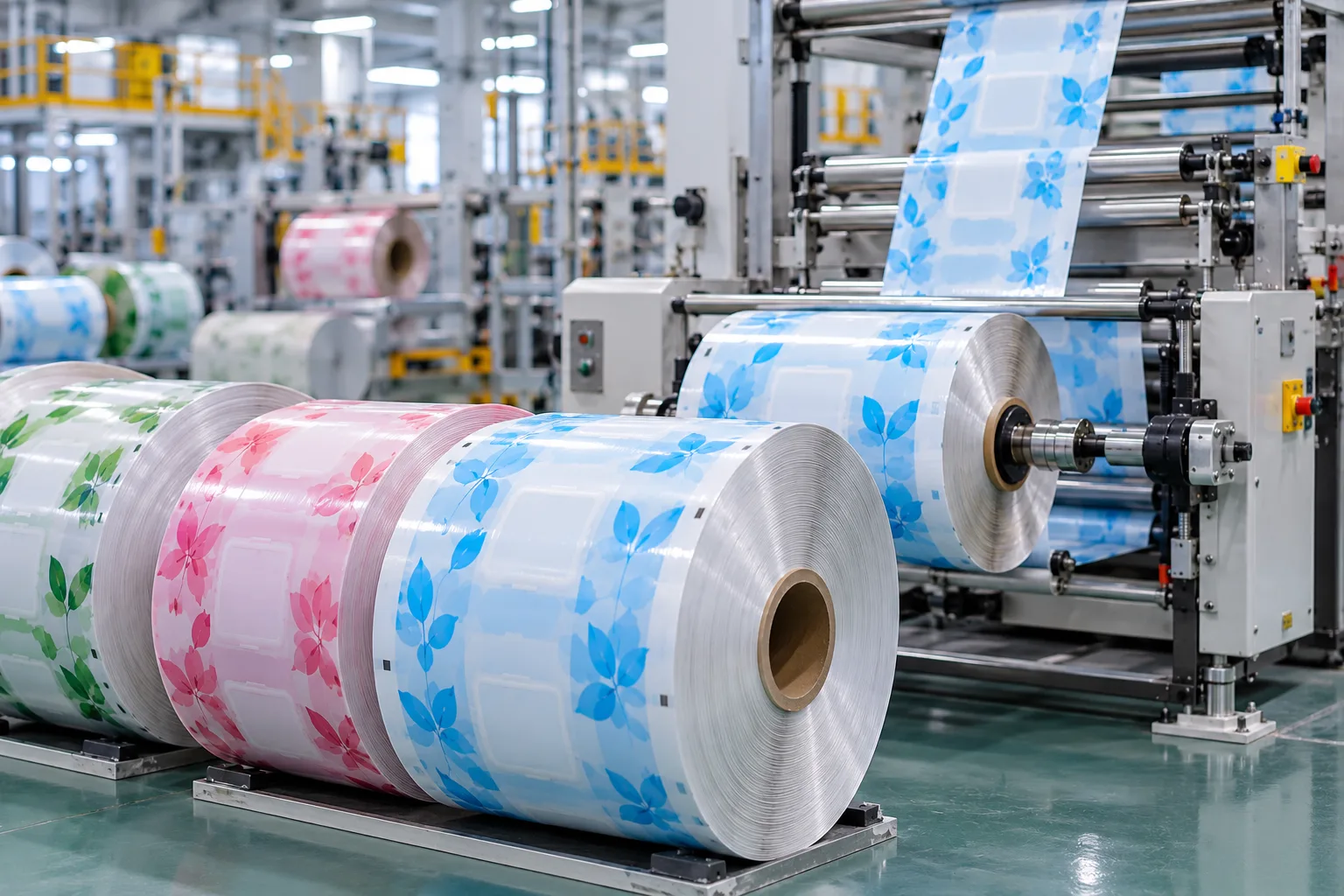
The film structure is the recipe for your bag. A single layer of PE film costs less than a laminated structure that joins two or three films together. Laminates add strength, print protection or barrier, but each extra layer adds material, adhesive and a lamination step.
Thickness is measured in microns. Thicker film is stronger and feels more premium, but you pay for every extra micron across the whole order. Ask your supplier what thickness your pack really needs for its weight and the way it will be handled. A heavy pack of adult diapers needs more strength than a light pack of face masks.
Printing method and colour count
This is where most of the one time cost comes from. Printed packaging film is usually made with flexographic or gravure printing, and both need a separate printing tool for each colour.
- Flexo uses a flexible photopolymer plate for each colour. Plates cost less to make, so flexo printing is usually the better value for medium runs.
- Gravure uses an engraved copper cylinder for each colour. Cylinders cost more up front, but they give photographic detail and very consistent colour over long runs. On our gravure lines, typical runs start from 50,000 to 100,000 units.
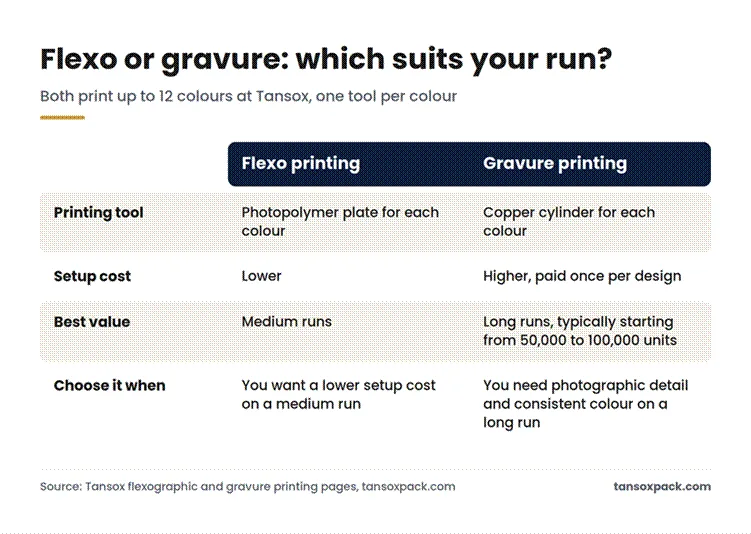
Because the tooling is per colour, colour count matters. At Tansox, both methods can print up to 12 colours, and a design with eight colours needs eight plates or cylinders, while a design with four needs four. Removing one or two colours that add little to the design can lower your setup cost with little change to shelf impact.
Digital printing skips plates and cylinders altogether. It suits very short test runs, but it is priced for small quantities rather than volume production.
Finishes and features
Every feature you add is another material or another machine step. Common add ons include:
- zippers and press to close seals for reclosable packs
- carry handles on large diaper and underpad bags
- clear windows so shoppers can see the product
- tear notches, hang holes and easy open features
- premium effects such as hot stamping, embossing or matte and gloss contrast
Features can lift your brand on the shelf, so they are often worth paying for. Add them because shoppers use or notice them, not by default.
How order quantity changes your unit price
Quantity is the biggest lever you control.
Why setup costs shrink as volume grows
Setup costs are paid once per design. Spread across a bigger order, they add less to each pack. The example below uses round numbers to show the maths only. They are not Tansox prices. Assume the setup costs 1,000 and each pack costs 0.10 to make, in any currency.
| Order quantity | Setup share per pack | Unit cost per pack | Total cost per pack |
|---|---|---|---|
| 10,000 | 0.10 | 0.10 | 0.20 |
| 50,000 | 0.02 | 0.10 | 0.12 |
| 100,000 | 0.01 | 0.10 | 0.11 |
Going from 10,000 to 50,000 packs cuts the cost per pack by 40% in this example. Going from 50,000 to 100,000 saves far less. That is the usual pattern: big savings over the first few price breaks, then the curve flattens. Ask for quotes at two or three quantities so you can see where the savings level off for your design.
In real quotes the unit cost also tends to fall a little on longer runs, because the film wasted while setting up the press is shared across more bags. Cylinders are also a one time cost per design. When you reorder the same artwork, the cylinders are normally reused, so a repeat order often costs less per pack than the first one.
Why smaller bags can have a higher MOQ
Minimum order quantity (MOQ) is really about machine time and film length, not the number of bags. A press has to run a certain length of film to be worth setting up. Small bags use little film each, so it takes more of them to fill that run.
That is why Tansox sets an MOQ of 10,000 pieces for large pouches but 50,000 pieces for small ones. Rollstock film is different again: its minimum is set by weight, at 500 kg. If you buy printed rollstock for a form fill seal line, compare quotes on cost per finished pack, not just price per kilogram, because a thinner film gives you more packs per kilogram.
Costs that sit outside the unit price
A low unit price can still turn into an expensive order. These costs are easy to miss when you compare quotes.
Raw material prices and quote validity
Packaging film is made from resins such as PE and PP, and resin prices move. A recent Packaging Gateway analysis explains that resin prices respond to plant capacity, outages, inventories and demand, not just oil prices, and that they can differ from one region to another. It also points out that a 10% rise in one raw material lifts total production cost by less than 10%, because materials are only part of the cost.
For buyers, this means two things. First, check how long each quote stays valid. Second, if you sign a long supply agreement, agree in writing how and when prices can change, and make sure the terms work in both directions.
Incoterms: FOB, EXW and what you still pay
Two quotes for the same bag can look very different because of trade terms. Incoterms are the standard rules that set who pays for and manages each step of an international shipment. The US International Trade Administration explains that each Incoterm sets out who handles shipping, insurance, documents and customs clearance.
The two terms you will see most often from factories in China are:
- EXW (Ex Works): you collect the goods at the factory and pay for everything after that point.
- FOB (Free on Board): the supplier loads the goods onto the ship at the named port, such as Xiamen. You pay sea freight, insurance and all costs at your end.
Tansox quotes FOB Xiamen, FOB Quanzhou or EXW. Whichever terms you choose, compare quotes on the same basis, then add your freight and port costs to find the landed cost per pack.
Import duty and free trade agreements
Import duty is set by your own country and depends on the product's tariff code. For buyers in Southeast Asia, the ASEAN and China Free Trade Area (ACFTA) can help. Malaysia's trade ministry explains that ACFTA Form E is the certificate of origin that member countries accept for preferential tariff treatment. In plain terms, goods that qualify can enter at a lower duty rate.
Rates and rules of origin depend on the product code and your country, so check with your customs broker before you order. Then ask your supplier whether they can provide a Form E with the shipment.
How to lower your packaging cost without cutting quality
These steps reduce cost without making your pack weaker or less attractive:
- Use fewer designs. Every separate design needs its own set of plates or cylinders. If several variants use the same bag size, ask whether they can share the background cylinders, so only the cylinder carrying the changing text or colour is new.
- Standardise bag sizes. Fewer sizes means fewer setups and longer runs of each one.
- Match the print method to the run. Choose flexo for medium runs and gravure for long runs.
- Trim colours that don't earn their place. Each colour removed is one less plate or cylinder.
- Right size the film. Ask for the thinnest structure that passes your handling tests. If recyclability matters to your brand, ask about mono material structures at the same time.
- Order fewer, bigger runs. If you have the storage space, combine forecast volume into one run instead of several small ones.
- Approve a printed sample first. Through our sampling service, printed samples take 7 to 15 working days after artwork approval and catch size or colour problems before a full run.
How to get an accurate packaging quote
A vague request gets a vague price. Send these eight details in your first message and you will get a firm quote much faster.
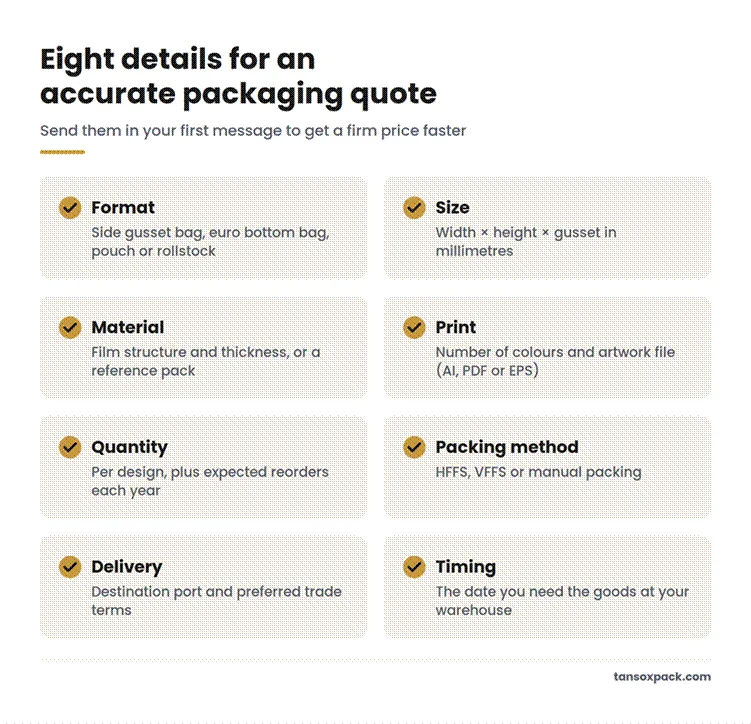
- Format: side gusset bag, euro bottom bag, pouch or rollstock
- Size: width × height × gusset in millimetres
- Material: film structure and thickness, or a reference pack
- Print: number of colours and your artwork file (AI, PDF or EPS)
- Quantity: per design, plus expected reorders each year
- Packing method: HFFS, VFFS or manual packing
- Delivery: destination port and preferred trade terms
- Timing: the date you need the goods at your warehouse
If you are unsure about the right structure, send a photo of a pack you like and the product it will hold. A good supplier will suggest a structure and explain the price difference between the options. It is also fair to ask for proof of quality systems. Tansox's management systems are certified to ISO 9001 and ISO 14001, and you can view our certificates before you order.
Frequently asked questions
Is custom packaging expensive for small orders?
Per pack, yes. Setup costs are fixed, so a small order carries a larger share of them on each pack. Printed flexible packaging becomes good value at volume. At Tansox, the MOQ for large printed pouches is 10,000 pieces.
Do I pay for printing cylinders again when I reorder?
Not usually. Cylinders are a one time cost per design and colour. If your artwork stays the same, the cylinders are reused. If you change one colour or one line of text, only the cylinders for the changed colours need to be made again.
Why do quotes from different suppliers vary so much?
Quotes often differ in film structure, thickness, colour count, print method, whether tooling is included and which trade terms apply. Line up these details before you compare the unit price, so you are comparing like with like.
How long does a custom packaging order take?
At Tansox, printed samples take 7 to 15 working days after artwork approval, and production takes 10 to 25 working days after the cylinders are confirmed. Add sea freight time to your port.
How should I compare rollstock film quotes?
Rollstock is ordered by weight rather than by piece, with a 500 kg minimum at Tansox. Convert each quote into a cost per finished pack, because a thinner film gives more packs per kilogram.
The bottom line on packaging cost
So, how much does custom packaging cost? For printed flexible packaging, it is the one time setup, plus the unit cost multiplied by your quantity, plus delivery and duties. Format, film, printing and quantity set most of the price, while trade terms, resin prices and import duty decide what you really pay at your door.
The fastest way to a real number is a quote built on your exact pack. Explore our flexible packaging range to choose a format, then send us your size, quantity, material and destination port. Tap WhatsApp Us or Get a Quote to start, and we will reply within one business day.